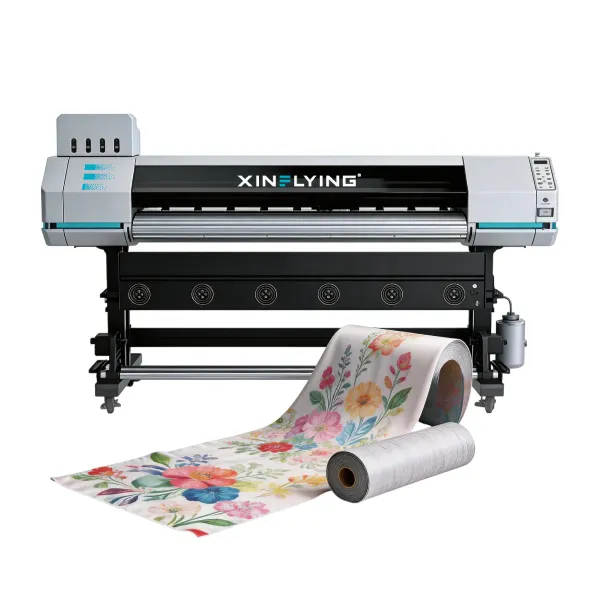
Rapidly shifting consumer preferences toward custom sportswear and personalized home textiles continue to redefine global digital printing demands. Adopting a wide format sublimation printer allows textile manufacturers to process roll-to-roll fabrics with precise color fidelity and rapid turnaround times across high-volume orders.
Industrial dye transfer technology provides commercial print facilities with scalable output capabilities while minimizing material waste. Strategic investments in modern heat transfer hardware help garment producers meet tight seasonal delivery schedules without expanding physical factory footprints.
Global Growth Drivers in Digital Textile Production
Market expansion across the digital textile sector reflects growing commercial demand for short-run apparel production and lightweight soft signage. Synthetic fabric processors increasingly replace conventional rotary screen methods with digital dye transfer systems to reduce setup costs and water consumption.
Global supply chain localization encourages regional apparel brands to adopt flexible digital manufacturing setups. On-demand textile printing reduces excess inventory risks by allowing companies to print fabric graphics only after consumer orders are confirmed.
Shift Towards On-Demand Fashion and Apparel Customization
Consumer demand for custom activewear, promotional garments, and personalized fashion capsules continues to accelerate market adoption. Operating an industrial Sublimation Printer enables apparel brands to execute intricate, full-color designs without paying additional fees for separate color screens.
Digital file preparation allows print operators to modify artwork files instantly, facilitating rapid prototyping and sample development. Flexible order quantities help emerging apparel businesses offer wide product catalogs while maintaining lean material inventories.
Technical Specifications of Dual-Printhead Hardware
Commercial hardware platforms combine precision motion control with multi-head arrays to maintain drop placement accuracy over broad media spans. Equipment engineered by Xinflying integrates synchronized drive motors that regulate carriage movement across continuous production shifts.
Engineered models like the XF-1802 utilize dual Epson i1600-A1 printheads to yield smooth color transitions and sharp line clarity. Utilizing a wide format sublimation printer equipped with twin-head configurations balances rapid square-meter output with fine photographic resolution across various synthetic substrates.
Ink Atomization and Fine Detail Rendering Mechanics
Micro-piezoelectric firing elements generate controlled pressure waves that push microscopic dye droplets through precision nozzle channels. Dynamic drop size control allows machinery to construct delicate tone shifts while preserving deep color density across solid background areas.
Uniform ink atomization prevents visible pass banding and edge blurring on detailed vector graphics. Maintaining constant fluid viscosity ensures reliable drop trajectories during long operational cycles on high-speed textile lines.
Material Dynamics in Synthetic Fabric Processing
Polyester matrices absorb vaporized disperse dyes when exposed to temperatures near 200°C under heat press pressure. Running a high-speed Sublimation Printer preserves fabric breathability because dyes bond directly inside synthetic fibers rather than forming a surface layer.
Coated transfer paper selection influences overall ink yield and transfer efficiency during heat calendar processing. Lightweight papers optimize drying speeds during roll-to-roll processing, whereas heavier coated options hold complex graphics without paper cockling.
Operational Cost Efficiency and Material Savings
Streamlining consumable usage remains a core priority for commercial print shop managers seeking to maximize operational margins. Deploying the XF-1802 in sportswear production settings helps managers control ink consumption while sustaining high daily throughput.
Digital dye transfer processes generate negligible wastewater compared to traditional wet dyeing methods, lowering utility expenses. Solutions from Xinflying provide balanced entry points for textile businesses aiming to reduce total operating costs across contract runs.
Workflow Integration in Modern Print Facilities
Digital raster image processors convert vector files into precise raster data and ink limit profiles prior to execution. Implementing a wide format sublimation printer within existing workflows streamlines job preparation and automates color matching across diverse fabric batches.
Integrated software platforms calculate exact ink consumption metrics before printing starts, helping estimators generate accurate job quotes. Automated file nesting arranges multiple graphics across the print width, cutting transfer paper waste.
Sustainable Manufacturing and Resource Conservation
Environmental regulations drive commercial textile producers toward waterless dye processes and non-toxic ink formulations. A modern sublimation printer utilizes water-based disperse dye formulations that emit minimal volatile organic compounds during thermal fixation. By nearly eliminating airborne pollutants and wastewater discharge from the coloration stage, digital sublimation offers a measurable pathway toward carbon-neutral and zero-liquid-discharge manufacturing goals.
Reduced chemical consumption helps textile processing facilities comply with international environmental standards while creating cleaner working conditions. Sustainable manufacturing practices align commercial print providers with eco-conscious corporate buyers.
Hardware Reliability and Maintenance Standards
Preventative maintenance schedules preserve printhead nozzle integrity and protect sensitive electronic components from ambient dust build-up. Automated capping stations and wiping assemblies clear residual ink from nozzle plates between active printing shifts.
Long-term mechanical stability depends on robust chassis construction and high-grade linear motion components. Preventative routines supported by Xinflying extend hardware service life, protecting machinery investments across demanding industrial shifts.
Conclusion
Commercial textile processing continues to transition toward digital heat transfer solutions that combine fast turnarounds, vibrant color output, and flexible batch capabilities. Evaluating technical parameters and hardware reliability equips factory managers to optimize daily operations and meet evolving global textile demand.