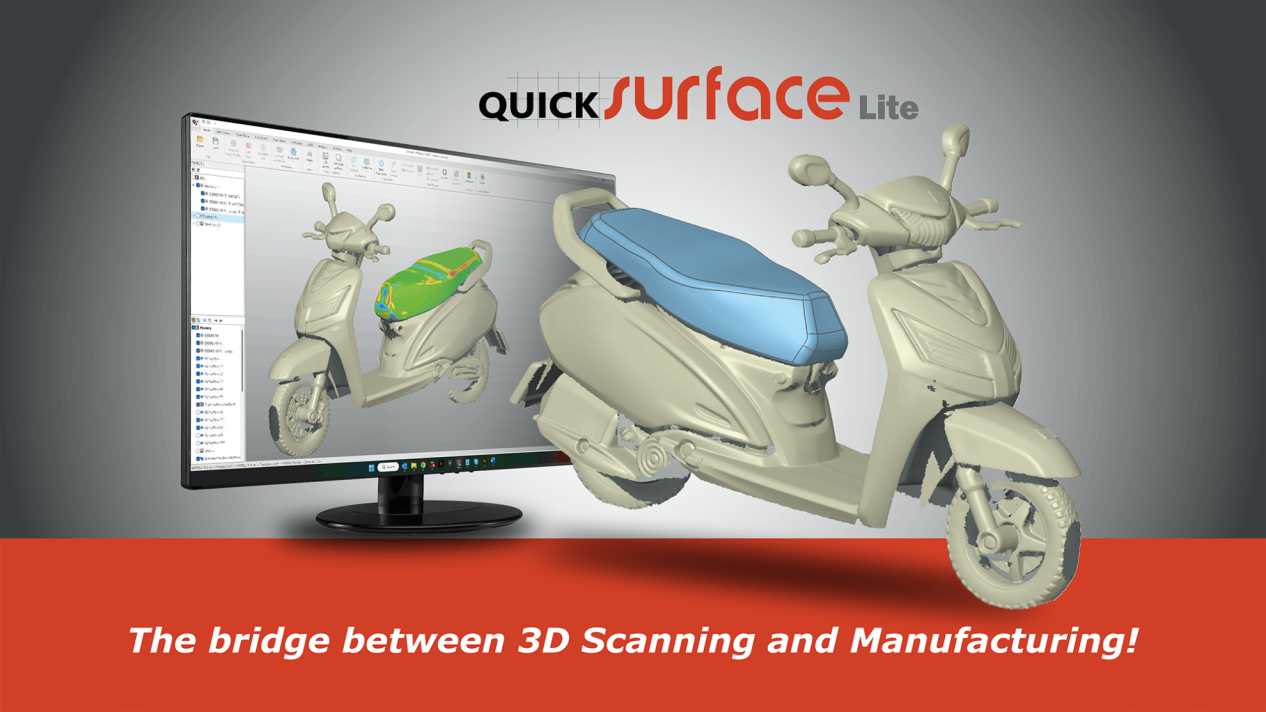
3D reverse engineering is the process of improving or recreating physical parts in the digital world. This is very important for making things, designing cars, building airplanes, and making medical devices. Professionals always have to turn the huge, unchanging data that a 3D scanner collects into a CAD model that is accurate and can be changed. To answer the question “what is the best software for 3D reverse engineering?” you need to look beyond regular CAD programs and find specialized platforms that are made for this kind of data conversion. A dedicated solution, like QUICKSURFACE, that works well with high-accuracy capture hardware like the 3DeVOK scanners is always the best choice. A modern, efficient digital workflow is made up of powerful scanning tools and smart 3D reverse engineering software.
The One-of-a-Kind Digital Challenge of Converting Scan Data
The first step is for a scanner to make a high-density mesh or point cloud that shows the surface of a physical object as millions of separate vertices and facets. This mesh is a good representation of the surface in terms of geometry, but it doesn’t have the mathematical properties that traditional Computer-Aided Design (CAD) systems need, like planes, cylinders, fillets, and splines. Standard CAD programs are made for constructive design, which means they start with mathematical features to make a shape. They are not good at understanding and changing a raw mesh. Because of this, you need special 3D scan reverse engineering software to understand the mesh, figure out what the original design was, and use CAD-compatible mathematical geometry to rebuild the object. This is the difference between a digital picture that is correct and an engineering file that can be changed and edited. The specialized software acts as the smart translator, making the most time-consuming part of the reverse engineering process easier.
Important Parts of Professional Reverse Engineering Software
The best 3D reverse engineering software can use a hybrid modeling approach, which combines the accuracy of automated surfacing with the control of manual feature extraction. The software needs to have very accurate Automatic Surfacing tools for free-form organic shapes, like complicated car panels or the human body. These features quickly cover the complicated mesh with NURBS (Non-Uniform Rational B-Splines) patches, which reduces the amount of work that needs to be done by hand while keeping the scan data smooth and true to the original. For prismatic or mechanical parts, where accuracy in manufacturing is very important, the software needs to have smart Feature Extraction tools. With this feature, the user can click on a part of the mesh and instantly fit a mathematically perfect primitive shape, like a cylinder, plane, or cone, no matter how much noise there is in the scan data. High-end software also has powerful Deviation Analysis tools that let engineers see in real time exactly how their rebuilt CAD surfaces differ from the original scan data, usually shown on a color map. This makes sure that all important tolerances are met before moving on to manufacturing.
QUICKSURFACE: The Answer for Fast, Mixed Modeling
The industry recognizes that true efficiency requires software built specifically for scan data processing. QUICKSURFACE stands out as a professional 3D reverse engineering platform designed to accelerate the transition from scan to CAD. Its unique approach bypasses the rigid, multi-step workflows of traditional CAD systems, offering instead intuitive sketch-based modeling directly on the mesh.
Engineers can effortlessly draw cross-sections and use intelligent fitting tools to generate arcs, lines, and splines that precisely match the original scan data, instantly converting 2D sketches into 3D CAD features. The software excels at handling complex surface transitions like blends and fillets between scan-extracted surfaces, while continuously validating CAD geometry against the reference mesh to ensure metrology-grade accuracy.
QUICKSURFACE’s significance lies in seamlessly integrating free-form organic modeling with precise mechanical design within one environment. This dual capability, combined with specialized optimization for 3DeVOK’s high-precision scanners, makes it a superior choice for diverse reverse engineering projects, dramatically reducing model reconstruction time compared to conventional CAD platforms.
Easy to use with the 3DeVOK Ecosystem
The “best” solution isn’t just one piece of software; it’s a whole ecosystem that makes sure data is always available and reliable. The 3DeVOK professional workflow puts a lot of emphasis on this synergy. Scanners quickly and accurately capture data and send clean, registered point clouds straight to the 3D scan reverse engineering software for processing. QUICKSURFACE then uses this improved data to quickly make the final CAD surfaces and solid models. When the model is done, the software makes sure it can be used in every downstream application by supporting Universal Export Formats that work with all major CAD/CAM systems, such as STEP and IGES, as well as standard mesh formats like STL and OBJ. This smooth integration—from the accurate, multi-sensor capture of a 3DeVOK scanner to the smart, feature-based reconstruction in QUICKSURFACE—reduces the need for manual rework and translation errors. The best option for 3D reverse engineering is the integrated solution that ensures accuracy from the first capture to the final CAD file that can be edited.