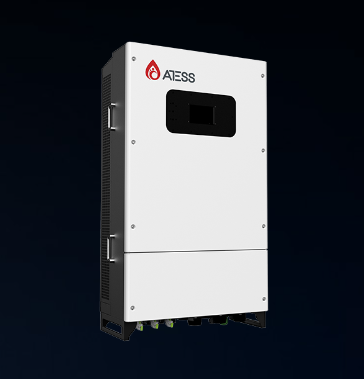
Commercial and industrial energy sites often need to keep loads running while managing variable solar output and rising electricity costs. A hybrid inverter provides a single platform that connects solar arrays, battery storage, and the utility grid, helping operators maintain supply continuity and improve energy utilization. Atess has developed a line of hybrid inverters for solar that addresses these overlapping requirements by combining multiple power paths in one coordinated device.
Managing Power During Grid Interruptions
When utility supply fails, immediate backup is critical. Atess states that their systems support both on-grid and off-grid operation and can switch modes within 10 milliseconds during a grid disturbance. The hybrid inverter detects the outage, disconnects from the grid, and begins supplying protected loads from the battery and solar inputs. This transition happens fast enough that sensitive equipment often stays online without manual intervention. For sites where downtime carries high costs, the integrated design simplifies the switchover by eliminating separate transfer switches and external controllers.
Improving Energy Storage and Self-Consumption
Many solar installations lose value when surplus daytime generation cannot be stored. Atess’s hybrid inverters for solar direct excess photovoltaic power toward battery charging instead of exporting it to the grid at low feed-in rates. Once solar production drops, stored energy is discharged to cover demand, which helps raise self-consumption ratios. The system manages power flow among solar, battery, grid, and load connections according to programmable priorities. This gives facility managers the flexibility to time-shift energy use, reduce peak-demand charges, and keep critical circuits powered during utility rate windows when electricity is most expensive.
Supporting Different Project Requirements
Atess offers units ranging from 5 kW to 150 kW, with selected models configurable for system capacities up to 1200 kW. The hardware includes multiple maximum power point trackers, adjustable battery voltage ranges, and user-selectable working modes. These features allow a single platform to adapt to small commercial rooftops as well as larger industrial arrays with varied string layouts and battery chemistries. By covering a wide operating envelope, the equipment can be matched to site-specific constraints without requiring completely different product families.
A hybrid inverter addresses practical concerns such as backup readiness, storage utilization, and scalable deployment. Atess’s hybrid inverters for solar combine these functions within a coordinated architecture, giving operators a straightforward way to maintain power availability and get more value from their solar-plus-storage investment.