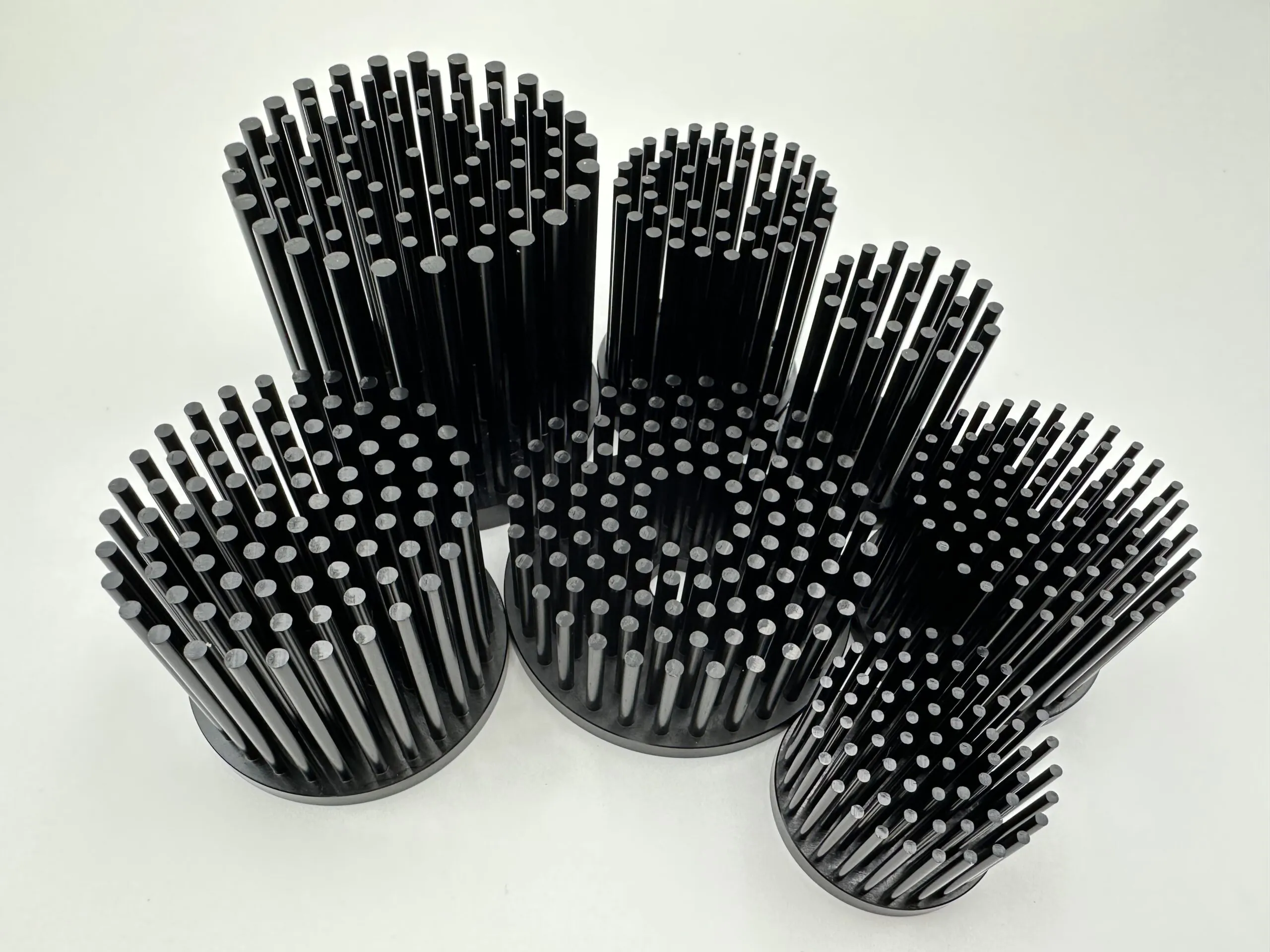
Choosing a suitable cold forged heat sink begins with identifying how the device will be used, what thermal loads it will encounter, and how much space engineers can allocate within the assembly. In many industrial projects, teams focus on operating temperature, airflow direction, and integration requirements before reviewing specific geometries. When working with suppliers such as Dingmetal, customers often assess these conditions to understand which material and fin layout can maintain temperature stability in actual use.
A cold forged aluminum heat sink is produced through a forging process that uses high pressure at room temperature to shape aluminum or copper without introducing thermal deformation. This method helps retain the natural conductive characteristics of the metal while offering strong structural integrity. Because cold forging provides accurate material flow, it also supports the formation of tall and thin fins that are difficult to achieve with standard machining, reducing material waste and providing better thermal pathways.
Material Considerations for Consistent Thermal Behavior
Material selection is a decisive step when evaluating any cold forged heat sink, especially for modules requiring predictable performance under continuous load. Aluminum is widely used due to its conductivity-to-weight ratio, making it suitable for applications in mechanical structural components, thermal control modules, and compact cooling systems. Copper, with higher thermal conductivity, is selected for assemblies that operate under heavier heat flux, though weight and compatibility must also be considered.
When they manufacture a cold forged aluminum heat sink, they pay attention to uniform grain alignment produced during forging. This structure encourages consistent thermal behavior throughout the component. Engineering teams appreciate this stability because it allows for reliable simulation and precise temperature prediction during development. For customers responsible for procurement or system integration, having a predictable material base reduces risks related to long-term use and potential thermal fatigue in environments with frequent temperature cycling.
The Role of Fin Geometry in Practical Thermal Management
Fin design is another important parameter influencing how effectively a cold forged heat sink dissipates heat. Fin height, spacing, and wall thickness shape the airflow pattern and determine the available surface area. Cold forging supports tight tolerances, allowing designers to achieve narrow spacing or taller fins that increase contact with moving air. In passive systems, wider spacing may help natural convection, while forced-air systems may require denser or thinner fins for greater efficiency.
Suppliers like Dingmetal often help engineering teams evaluate the relationship between fin layout and total thermal resistance. Differences in pressure drop, airflow direction, and structural stiffness can influence the final decision. A precisely formed cold forged aluminum heat sink helps maintain smooth airflow paths, lowering resistance across the fins and improving thermal uniformity. This becomes particularly relevant for equipment that must operate continuously and maintain predictable heat distribution over long running cycles.
Conclusion: Using Material, Geometry, and Resistance as Core Evaluation Criteria
Selecting an appropriate cold forged heat sink requires balancing material characteristics, fin design possibilities, and the thermal resistance target that matches the application. With the support of experienced manufacturers such as Dingmetal, engineering teams can evaluate design options with clarity, ensuring each parameter aligns with functional requirements and assembly constraints. Understanding how the forging process enhances material density and fin accuracy further enriches the selection process.
By reviewing the material structure and design geometry, procurement and R&D teams can confidently select a cold forged aluminum heat sink that supports stable heat dissipation performance in real industrial settings. Each decision—whether related to metal type, fin spacing, or expected airflow—contributes to the reliability and durability of the final device.