Critical commercial and industrial loads cannot always tolerate the interruption associated with conventional mechanical switching. Data centers, semiconductor facilities, manufacturing lines, energy storage systems, and other mission-critical installations may need to move between independent AC sources while keeping sensitive equipment energized. A solid-state static transfer switch (STS) addresses this requirement by using power semiconductors and continuous electrical monitoring instead of mechanically moving contacts.
For system integrators and facility engineers, the value of an STS is not simply its switching speed. Source synchronization, voltage monitoring, transfer logic, fault protection, bypass arrangements, and maintainability all influence whether a high-power transfer system can deliver dependable continuity.
Why Milliseconds Matter for Critical Loads
A transfer switch is installed to move a load from a preferred power source to an alternate source when the preferred source becomes unavailable or falls outside defined electrical limits. Mechanical ATS equipment relies on the movement of physical contacts, which can result in a comparatively longer transfer interval.
An STS replaces that mechanical action with semiconductor switching. Technical literature describes thyristor-based STS equipment as a solution for sensitive loads because it can transfer power within a short electrical interval.
This distinction matters when loads have limited voltage ride-through capability. Modern IT and electronic equipment can be sensitive to short-duration voltage disturbances, making fast source transfer an important part of the overall power architecture.
How Does a Solid-State Transfer Switch Switch So Quickly?
The central component of an STS is its power semiconductor, commonly a silicon-controlled rectifier (SCR), also known as a thyristor. Unlike a mechanical contactor, an SCR does not need to physically move from one position to another.
The control system continuously monitors the two incoming sources. Voltage magnitude, phase relationship, frequency, and source availability are evaluated before a transfer command is issued. Research on thyristor-based STS control shows that transfer strategies must carefully manage the transition between sources to avoid excessive cross-current or other electrical disturbances.
When the preferred source experiences an unacceptable condition, the controller initiates the transfer sequence and triggers the appropriate semiconductor devices. The load is then connected to the alternate source within the specified transfer window.
Source Synchronization Is Essential
Fast switching does not mean the STS can connect two arbitrary AC sources at any moment. The electrical relationship between the sources is an important part of safe transfer operation.
A digital static transfer switch continuously monitors the incoming sources and can determine whether their voltage and phase conditions are suitable for transfer. ABB documentation, for example, describes digital STS systems that continuously monitor the voltage, phase, and waveform of independent sources.
This monitoring allows the controller to coordinate switching with the AC waveform. Appropriate synchronization can reduce transient disturbances and help prevent undesirable current flow between the two sources.
What Makes a Digital Static Transfer Switch Different?
The term digital static transfer switch generally emphasizes the control and monitoring architecture surrounding the solid-state switching devices. A modern STS is more than a semiconductor power path; it combines sensing, control logic, protection, communications, and switching hardware.
Digital control can support continuous source monitoring, event recording, alarm functions, and programmed transfer criteria. These capabilities are particularly useful in commercial facilities where operators need visibility into power events rather than simply knowing that a transfer occurred.
For system designers, this also creates opportunities to integrate STS equipment with broader facility monitoring and energy-management systems. Communication interfaces and event information can help maintenance teams investigate abnormal source conditions and verify system performance.
Why Transfer Speed Must Be Matched With the Application
Not every commercial load requires millisecond transfer. The appropriate architecture depends on the equipment being protected and the available power sources.
Critical IT equipment, industrial control systems, medical equipment, and other sensitive electronic loads may have much tighter interruption tolerances than lighting or general building services. An STS is therefore most valuable where maintaining continuity during a source disturbance has a significant operational or financial benefit.
The STS also does not replace every other element of a resilient power system. UPS systems, generators, energy storage systems, protective devices, and redundant feeders may all serve different functions. The transfer switch should be evaluated as one component within the complete electrical architecture.
Scaling STS Capacity for Commercial and Industrial Systems
High-power applications require careful attention to current capacity, thermal management, fault protection, source configuration, and maintenance access. A transfer system that works effectively at rack or small-equipment level cannot simply be scaled up without addressing these factors.
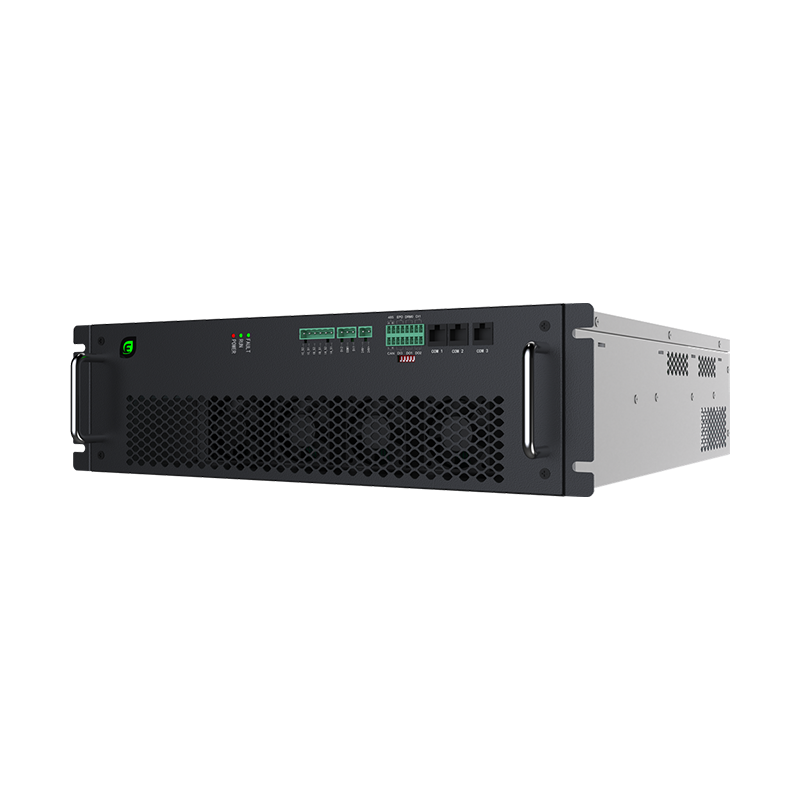
Enjoypowers offers a high-power STS platform for C&I energy storage and critical-load backup, with four ratings from 250 kW to 1000 kW. The 400 Vac series includes 250 kW, 500 kW, 750 kW, and 1000 kW configurations, allowing system integrators to select capacity according to the protected load.
For projects specifically evaluating a 500 kW STS, the 500 kW configuration provides a suitable reference point within this product family. Enjoypowers specifies a transfer time of under 20 ms across the series and uses thyristor-based solid-state switching with full-cycle voltage detection.
Designing Around Maintenance and Availability
High-power switching equipment must remain serviceable throughout its operating life. Maintenance requirements therefore deserve consideration alongside transfer speed.
Enjoypowers’ STS platform is designed with front-side maintenance and field-replaceable power modules. These features can help maintenance teams access the equipment without the extensive disassembly that may be required for less serviceable cabinet designs.
The system architecture should also consider bypass arrangements, upstream and downstream protection, source redundancy, and fault isolation. Research into STS systems highlights the importance of protection coordination and preventing faults in semiconductor switching elements from compromising critical loads.
Applying Millisecond Switching to Modern Power Systems
Solid-state transfer switches achieve fast source transfer by combining semiconductor switching with continuous electrical monitoring and coordinated control. Thyristors eliminate mechanical movement, while digital control determines when and how the load should move between sources.
For commercial and industrial projects, the correct STS specification should therefore consider more than the headline transfer time. Load characteristics, source synchronization, fault levels, maintenance strategy, communications, and required capacity all contribute to the overall design.
Enjoypowers‘ 250–1000 kW 400 Vac STS family provides a high-power option for these applications, with under 20 ms transfer, thyristor-based switching, and field-replaceable power modules. For engineers evaluating a 500 kW STS, these characteristics provide a practical starting point for integrating rapid source transfer into C&I energy storage and critical-load backup systems.