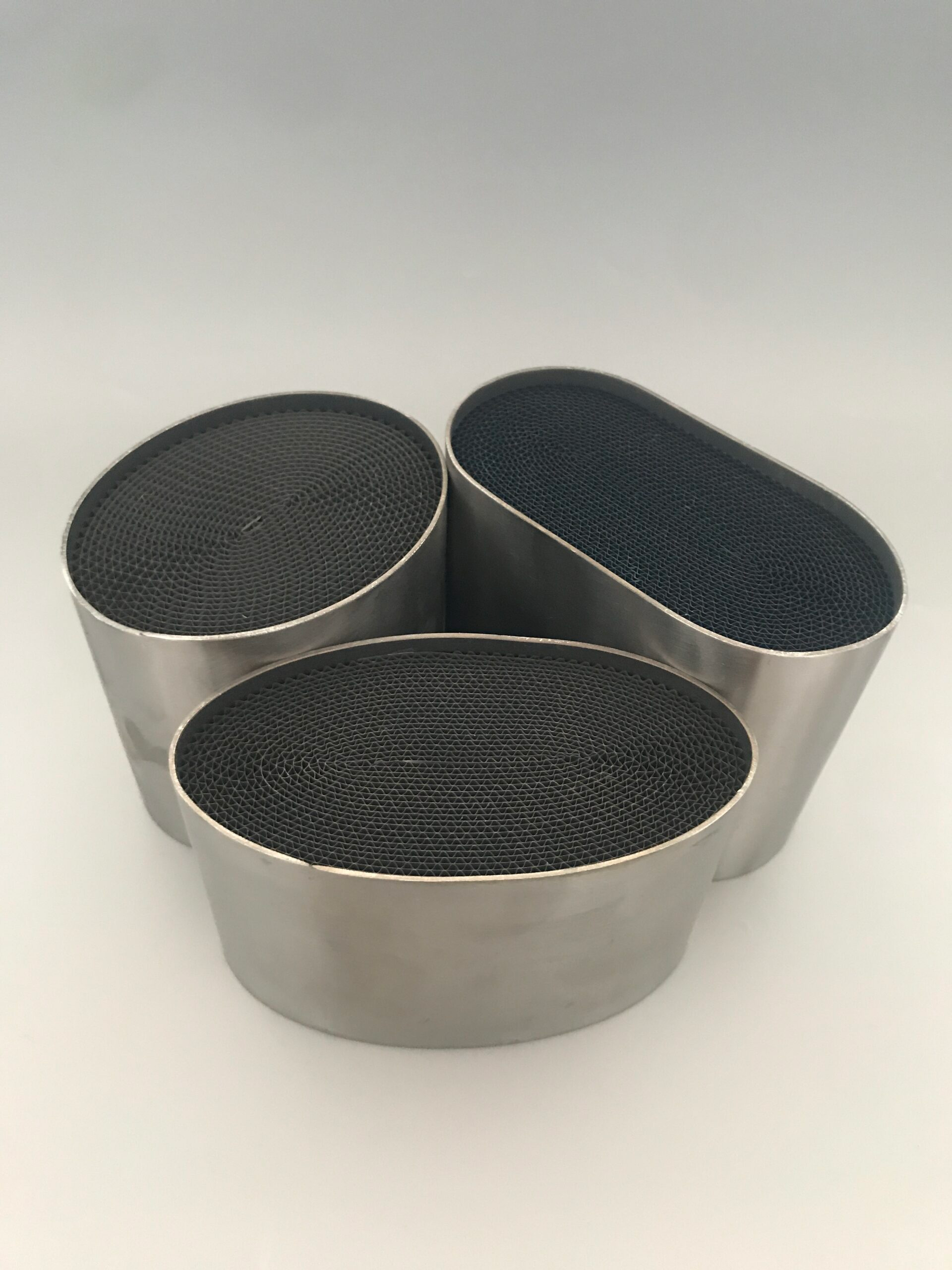
The number 400 CPSI describes channel density, not a guaranteed emissions result. In a metal converter it indicates how many cells occupy a square inch of substrate cross-section.
More channels can alter contact area and flow distribution, but wall thickness, coating, length, and exhaust rate also influence conversion and resistance. The downstream filter consumes part of the engine’s pressure allowance, leaving a finite margin for the chosen converter geometry.
A dpf diesel particulate filter adds a different kind of restriction. Its wall-flow geometry forces gas through porous channel walls, leaving soot behind; pressure loss then changes as the soot load grows.
Evaluating the 400 cpsi catalytic converter at a clean, steady test point while ignoring the filter’s changing state would give an incomplete account of backpressure. The balance has to hold across operating and regeneration conditions.
Understand What 400 CPSI Can and Cannot Say
Open frontal area and effective residence time can differ between two versions of a 400 cpsi catalytic converter, despite their matching channel count. Thin walls can preserve more flow area than thicker walls at the same cell density.
Coating thickness and substrate length can further alter both pressure drop and conversion. Performance claims therefore require measurements on the complete configuration at matched exhaust flow and temperature, not a cell-count label.
An engine may spend significant time outside the temperature range used in a single laboratory comparison. Under cooler conditions, additional surface area cannot substitute automatically for sufficient catalytic activity.
At high flow, reduced gas contact time may become important even if backpressure remains low. The chosen converter should be evaluated against both conditions rather than optimized for one attractive number.
Add the Filter’s Changing Pressure Loss
The dpf diesel particulate filter is not another open-through catalyst. Alternately plugged channels direct exhaust through porous walls, where soot is retained. Hualian Catalyst‘s DPF range lists Cordierite or SiC structures at 100, 200, 300, and 350 CPSI.
The product information describes capture of more than 95% of soot particles while aiming to maintain low backpressure; that stated capture figure should be assessed under the conditions of a particular application.
As soot accumulates, the filter’s resistance normally rises. Passive regeneration can remove soot when exhaust conditions permit, while active regeneration supplies additional heat when required.
Neither process makes filter pressure constant at every moment. A useful backpressure budget includes the converter, clean filter, representative loaded filter, connecting pipework, and the maximum state allowed before regeneration begins.
Conversion efficiency and filtration efficiency also measure different outcomes. A high CO or hydrocarbon conversion result at the metal unit does not predict soot capture at the DPF. Conversely, a filter that traps soot well may impose excessive resistance if its size or regeneration strategy is mismatched. The two devices must be evaluated against their respective performance targets and the shared engine limit.
A pressure trace across the filter can show when soot accumulation changes the operating state. The threshold for active regeneration and the drop after a completed event are useful observations, provided flow and temperature are recorded alongside them. A single end-point pressure value cannot distinguish a rapidly loading filter from one that reaches the same value only after much longer service.
Thin walls preserve flow area within a specified channel pattern. In Hualian’s metallic substrate range, which includes 400 CPSI, that construction is intended to limit exhaust resistance and support heat transfer.
Mechanical and thermal characteristics also affect installation, where housing and mounting determine the loads reaching the metal honeycomb. Conversion measurements at the actual engine’s flow and temperature points complete the comparison between the proposed configurations.
Test the Tradeoff over a Duty Cycle
The design question is not whether 400 CPSI is inherently preferable to another density. It is whether the selected substrate, coating, and filter maintain emissions control while leaving sufficient pressure margin through the cycle. Measurements should include conversion at relevant temperatures, pressure drop over the flow range, soot-loading behavior, and conditions during regeneration.
Changing converter cell density may alter the upstream restriction without solving a filter capacity problem. Changing filter size may ease pressure rise but affect packaging and thermal behavior.
The result of either change must be checked as a pair. The dpf diesel particulate filter and the 400 cpsi catalytic converter should therefore be assessed in the same flow and temperature envelope, with separate performance data for each.
Useful acceptance evidence includes a conversion curve for the converter, a soot-capture result for the filter, and pressure measurements at defined clean and loaded states. Those records should identify the tested dimensions and materials. Only then can another design be compared fairly: a lower pressure reading obtained with a smaller soot load is not an equivalent operating point.
A workable balance is visible in curves, not in one CPSI value. Conversion, soot capture, and backpressure evolve under different operating conditions and cannot be collapsed into a single rating. The final specification needs to show that the metal converter and wall-flow filter meet their respective duties while the engine remains within its allowable resistance throughout use.