Metal additive manufacturing is moving from prototyping toward increasingly demanding production applications. As this transition continues, the quality and management of feedstock have become just as important as printer hardware. For buyers evaluating a 3D printer metal powder supplier, material consistency, traceability, application compatibility, and sustainability are becoming central purchasing considerations. In 2026, several trends are shaping how manufacturers and laboratories select, qualify, and manage metal powders for additive manufacturing.
- Powder Quality Is Becoming a Core Production Priority
Metal powder is not simply a consumable added to a printer. Its particle size distribution, morphology, chemical composition, density, flowability, and contamination level can influence powder spreading and the stability of the printing process. ISO/ASTM 52907:2019 specifically addresses these characteristics, as well as documentation, sampling, packaging, storage, and traceability for metal powders used in additive manufacturing.
This trend is pushing buyers to evaluate powder suppliers more carefully. Instead of comparing price alone, procurement teams increasingly need technical documentation and consistent batch information. For a 3D printing metal powder manufacturer, the ability to provide controlled and traceable feedstock is therefore becoming an important part of its value proposition.
- Powder Reuse and Lifecycle Management Are Gaining Attention
Powder reuse has become an important topic as manufacturers look for ways to control material consumption and improve the economics of powder-bed fusion. However, reused powder cannot automatically be treated as identical to unused material. Repeated exposure, handling, sieving, blending, and processing can change powder characteristics.
ASTM F3592-23 provides guidance on powder reuse strategies and sampling for metal powder bed fusion, emphasizing the need to consider material type, process conditions, application requirements, and changes in powder properties.
Consequently, 2026 buyers are paying more attention to powder lifecycle management. Reliable suppliers are expected to support not only initial material selection but also appropriate quality-control practices throughout the powder’s usable life.
- Application-Specific Alloys Are Expanding
Another major trend is the development of metal powders designed around specific applications rather than treating one alloy as a universal solution. Aerospace, automotive, medical, dental, and industrial users can have very different requirements for mechanical performance, surface finishing, corrosion resistance, biocompatibility, and post-processing.
Recent technical reviews continue to identify powder-based additive manufacturing as a broad field encompassing technologies such as powder bed fusion, binder jetting, and directed energy deposition, with different powder-process interactions and application requirements.
For buyers, this means alloy selection should begin with the final application. A specialized 3D printer metal powder can offer advantages when its composition and processing characteristics have been developed around a particular production requirement.
- Digital Quality Control Is Moving Beyond the Printer
Metal AM quality management increasingly extends across the complete powder lifecycle. Modern production teams need to understand where variation enters during powder production, transportation, storage, sieving, reuse, and printing. Recent industry discussion has highlighted how changes in chemistry, particle-size distribution, morphology, and flowability can affect process stability, scrap rates, and production quality.
This creates demand for better documentation and measurable quality-control procedures. Advanced powder characterization can also help identify impurities and defects. Research has demonstrated the potential of micro-computed tomography for analyzing metal powder feedstock and supporting standardized powder analysis.
For a 3D printing metal powder manufacturer, quality assurance is therefore becoming a broader system rather than a single laboratory inspection.
- Sustainability Is Becoming Part of Material Decisions
Sustainability is increasingly influencing decisions across metal additive manufacturing. The technology can reduce material waste for certain geometries compared with conventional manufacturing, while enabling lightweight and complex designs. However, the environmental impact of powder production, processing, machine operation, and post-processing still needs to be considered.
Recent industry analysis examining metal additive manufacturing notes that environmental hotspots can occur across the manufacturing system and investigates circularity opportunities involving both powder and production processes.
This is encouraging manufacturers to look beyond the initial powder price. Powder yield, reuse strategy, packaging, production efficiency, and waste management can all contribute to the overall material footprint. Sustainability is consequently becoming a technical and economic consideration rather than simply a marketing message.
Riton’s Approach to Application-Focused Metal Powder
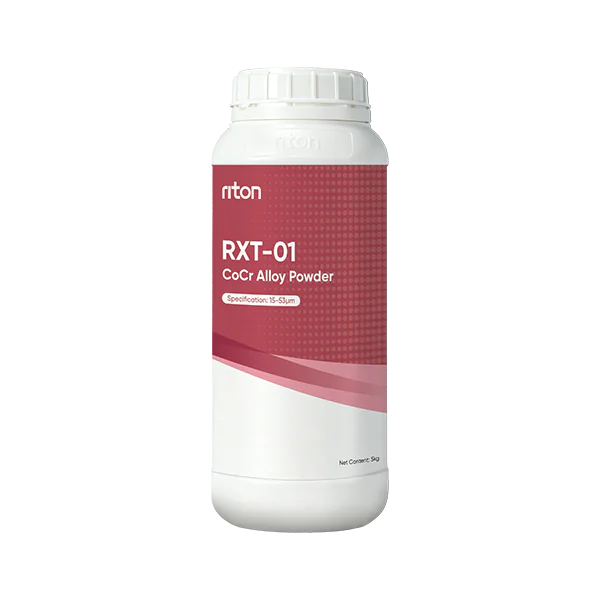
Riton illustrates the move toward application-specific feedstock with its RXT-01 CoCr Alloy Powder. Independently developed and produced by Riton, this CoCrW alloy powder is intended for dental selective laser melting. This formulation is free from nickel, cadmium, beryllium, and lead, addressing important material considerations for dental restoration applications.
The RXT-01 is designed for various dental products, including metal-ceramic restoration inner crowns and bridges, full crowns, bridges, inlays, posts and cores, removable partial denture frameworks and clasps, and complete denture frameworks. It also offers a relatively simple heat-treatment process and good polishing performance, alongside good biocompatibility.
What Buyers Should Watch Next
The 2026 metal powder market is increasingly defined by consistency, specialization, traceability, lifecycle control, and sustainability. Buyers should therefore assess more than alloy composition when comparing suppliers. Documentation, powder characterization, application suitability, processing requirements, and quality-control capabilities all deserve attention.
For laboratories and manufacturers seeking dental metal feedstock, Riton’s RXT-01 demonstrates how a specialized 3D printer metal powder can be developed around a defined production application. As additive manufacturing matures, leading suppliers will increasingly be judged not only by what powder they provide, but by how consistently and responsibly that powder supports the complete manufacturing workflow.