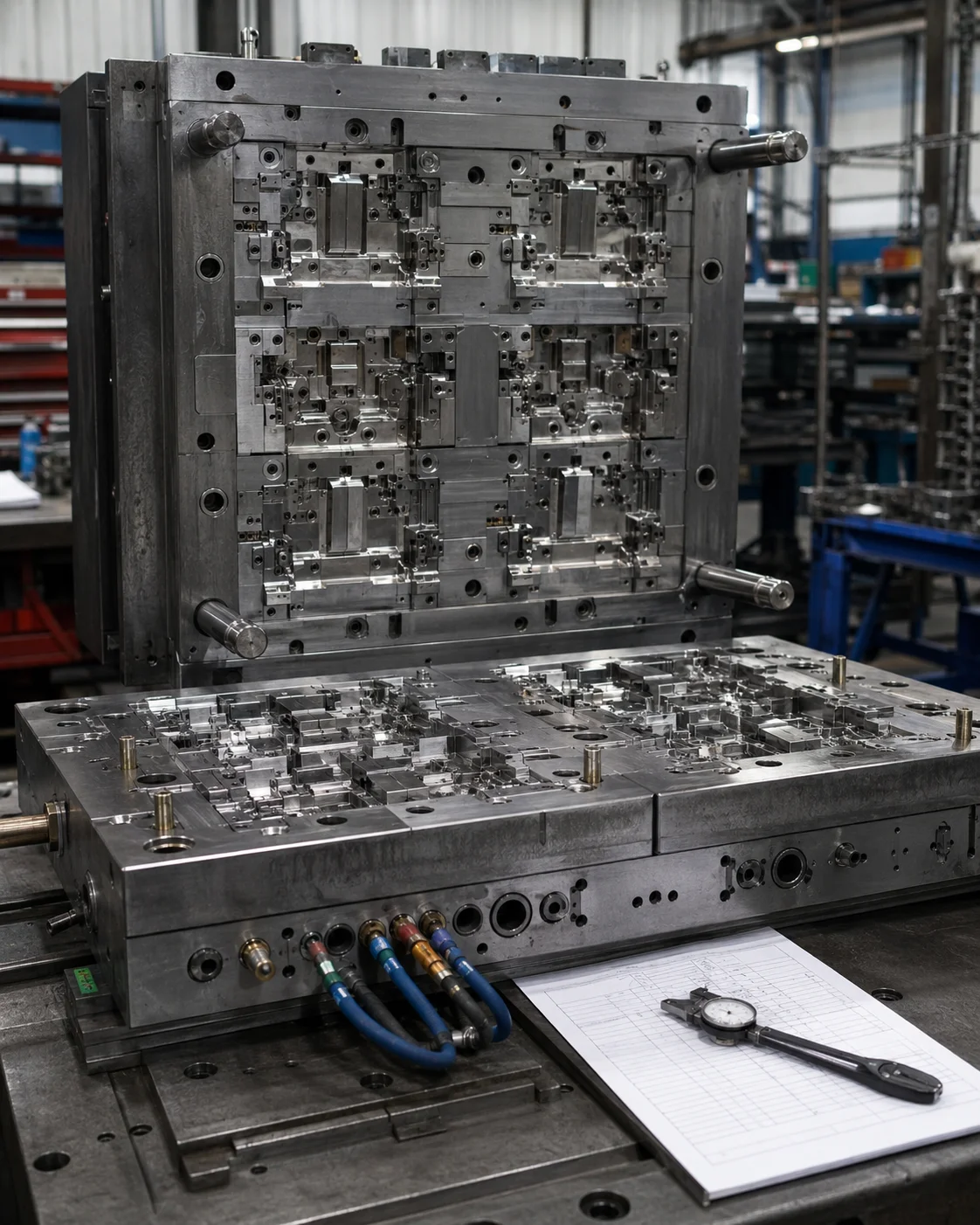
Committing capital to fully hardened production steel before finalizing complex mechanical geometries exposes hardware startups to severe financial vulnerability and unexpected project delays.
Minor dimensional errors discovered after cutting a multi-cavity production mold can trigger thousands of dollars in rework expenses and delay market entry significantly. Engineering teams must find ways to validate functional performance under real-world stress without incurring massive upfront tooling costs.
Deploying flexible short-run manufacturing strategies allows designers to test authentic engineering thermoplastics safely before locking down final production geometries. Balancing early capital exposure with rigorous physical verification is essential for maintaining project profitability and long-term commercial viability.
De-risking Hardware Design Iterations Prior to Hard-Tool Investments
When digital simulations and non-molded prototypes fall short of predicting actual assembly behavior, physical molding remains the ultimate benchmark for rigorous engineering verification. Establishing a dependable framework for initial sample production helps mitigate unforeseen design flaws before full-scale commercial manufacturing begins in earnest.
Organizations that plan their validation pathways carefully avoid the common trap of excessive tool modification expenses and unexpected redesign cycles. Proactive risk management during early product development cycles lays a sturdy foundation for dependable downstream performance.
Early-stage product development relies heavily on iterative testing to eliminate structural flaws, wall thickness inconsistencies, and assembly interference issues. When prototypes are restricted to layered samples, mechanical data often fails to reflect true injection-molded behavior under load. Transitioning to custom aluminum or soft steel inserts bridges this verification gap by utilizing genuine production-grade resins under authentic thermal pressures.
Organizations leveraging rapid tooling China pathways gain access to cost-effective iterative machining options that protect initial capital budgets. Evaluating real molded components prevents costly structural redesigns after mass production investments have already been finalized.
Optimizing Shot Life and Material Selection for Functional Testing
Selecting appropriate mold construction materials dictates whether an evaluation phase achieves its technical goals without premature component degradation under pressure.
Aluminum 7075 provides exceptional thermal conductivity and rapid machining speeds, making it ideal for low-volume functional testing cycles. Pre-hardened structural steel inserts offer extended durability when testing demands thousands of rigorous injection cycles with filled thermoplastics.
HordRT evaluates resin specifications, expected testing volumes, and mechanical loading requirements to recommend optimal mold construction routes. Matching the correct metal alloy to project requirements ensures that physical prototypes withstand rigorous mechanical and thermal stress testing reliably.
Understanding how different polymers behave during high-pressure injection prevents common defects such as sink marks, warpage, and incomplete filling issues during testing. Expert engineering reviews identify potential geometry vulnerabilities before any metal is cut on the shop floor.
This careful preparation guarantees that molded test articles exhibit true mechanical anisotropy and dimensional stability under operating loads. Technical alignment between designers and manufacturing specialists eliminates ambiguity throughout the entire tool creation cycle, ensuring smooth progression into subsequent manufacturing phases.
Leveraging Flexible MUD Inserts to Control Budgetary Exposure
Tooling expenditures often represent the single largest barrier for engineering teams striving to validate new plastic enclosures and mechanical housings. Utilizing shared master unit die insert systems allows project managers to swap specific core and cavity blocks inside a reusable base frame. This modular configuration drastically reduces initial tooling expenses by eliminating the need to machine a completely new base for every iteration.
HordRT implements these interchangeable cavity strategies to help clients scale development budgets efficiently across multiple product variants. Accessing rapid tooling china resources through modular frameworks ensures that financial resources remain focused on core engineering innovation.
Standardizing auxiliary mold components simplifies changeovers and accelerates delivery schedules for time-sensitive commercial development programs across highly competitive global markets.
Project coordinators track every modification closely to maintain complete traceability across all manufactured batch samples. Minimizing non-essential structural overhead keeps custom manufacturing accessible for growing enterprises seeking high-quality physical parts. Strategic deployment of modular insert systems represents a powerful mechanism for controlling financial exposure during product scaling phases.
Accelerating Commercial Entry Through Agile Pre-Production Runs
Securing initial market traction often requires small-batch production runs to satisfy early customer trials, regulatory evaluations, and pilot marketing campaigns. Waiting for hardened multi-cavity production systems to be completed can cause businesses to miss crucial window opportunities in fast-moving industries.
Agile short-run manufacturing bridges this transition gap by supplying production-grade components while final high-volume tooling is being fabricated. Integrating these pilot runs into the overall project schedule eliminates supply chain interruptions and ensures a smooth commercial rollout. HordRT provides responsive low-volume production services designed to support businesses from early functional testing straight through to market launch.
Deploying agile pre-production assets also enables companies to gather authentic end-user feedback before committing to massive manufacturing scales or high-volume commitments. Minor adjustments can be incorporated into subsequent batches swiftly without disrupting active assembly lines or inflating budgets.
Utilizing rapid tooling China capabilities empowers businesses to scale production volumes dynamically in response to actual market demand. Maintaining this operational flexibility ensures long-term resilience against unexpected market fluctuations and shifting customer requirements.
Balancing Cost, Validation, and Manufacturing Flexibility
Successfully bringing complex plastic hardware to market requires a disciplined balance between financial prudence and rigorous structural validation. Utilizing flexible short-run manufacturing options empowers engineering groups to iterate rapidly without risking excessive capital on premature steel molds. Sourcing these specialized capabilities internationally provides significant cost advantages while maintaining uncompromising dimensional precision and material compliance.
By prioritizing smart material selection and modular tooling strategies, modern enterprises can accelerate innovation cycles and secure long-term success. Careful planning during the initial phases eliminates downstream friction and guarantees robust component reliability across every commercial deployment.