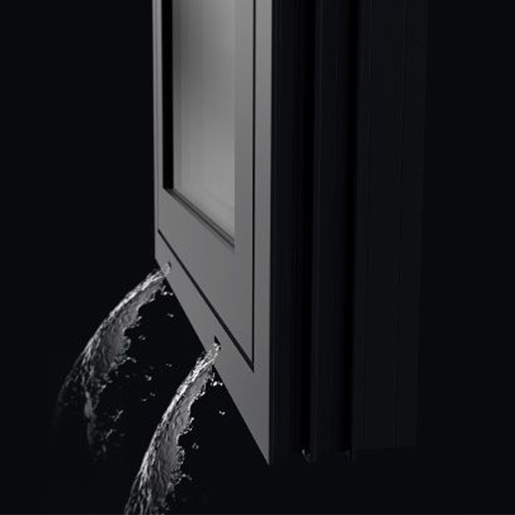
Imagine opening a window without endlessly turning a mechanical hand crank. You simply lift a sleek lever, push the glass sash outward, and feel it glide into position.
This effortless motion defines French-style push-out windows. Homeowners love them for their clean interior sightlines and classic architectural charm. But removing the traditional crank gear raises a critical engineering question: without a worm gear holding the sash open, how does a push-out window remain stable in strong winds and completely airtight when locked?
The answer lies in how internal forces are distributed through an integrated casement window hardware kit.
Why Ditch the Mechanical Hand Crank?
Traditional crank-driven windows rely on complex internal gearboxes mounted to the window sill. While functional, crank mechanisms come with persistent design drawbacks:
- Sluggish Operation: Opening the window requires turning a small handle multiple times.
- Interior Obstructions: Protruding crank handles get in the way of blinds, shades, and narrow sills.
- Mechanical Binding: Internal worm gears can strip or catch over time, making smooth operation difficult.
French-style push-out systems eliminate these problems. A direct push motion opens the sash in one fluid gesture.
Without a crank operator, the sash relies on the specified hinges and any fitted stay or restrictor to support controlled opening. The appropriate hardware depends on the window design and expected operating conditions.
What Holds a Push-Out Window Open in High Winds?
When you push a window open into a breezy outdoor space, wind pressure creates immediate force against the glass pane. Without proper support, the sash would slam shut or swing violently outward.
To prevent uncontrolled movement, high-performance systems utilize heavy-duty friction hinges. These components generate calibrated resistance along the frame pivot, allowing homeowners to set a precise ventilation angle that stays firmly in place.
For standard slim-frame profiles, such as 70 mm narrow frames, vertical weight distribution is another key challenge. Over time, heavy glass panes can cause the sash to sag, dragging against the lower frame during closure.
Engineering innovations solve this through patented structural reinforcement. For example, milling-free built-in hinges feature a U-shaped bent reinforcement plate anchored by six solid steel rivets. The milling-free built-in hinge features a patented anti-sag structure, a U-shaped reinforcement plate, and six solid steel rivets, with a specified load-bearing capacity of up to 50 kg.
When larger sashes require extended opening clearances, heavy-duty C-groove friction hinges take over. Built with 304 stainless steel friction arms and triple safety linkages, these hinges withstand up to 1,000 N of wind force—equivalent to Grade 9 strong winds—and pass rigorous 30,000-cycle operational tests for long-term stability.
How Does a Push-Out System Seal Against Severe Weather?
Pushing a window closed is only half the job. Locking it securely against heavy rain, winter drafts, and forced entry requires uniform compression along every edge of the frame.
A single latch handle placed at the center of the sash is not enough to maintain a weather-tight seal at the top and bottom corners. Instead, turning the primary lever handle engages an internal drive gearbox hidden within the profile channel.
This drive gearbox converts the single rotational motion of the handle into linear movement along lock transmission bars. These bars operate the specified locking points, engaging the corresponding keepers to secure the sash against the frame.
Key drive mechanisms utilize high-precision carbon steel gears treated with a nano-blue protective surface coating, offering high torque transmission alongside exceptional corrosion resistance. The 10 mm drive spindle is designed to improve torsional rigidity and support stable handle operation compared with the specified 7 mm alternative.
This continuous perimeter compression enables push-out windows to achieve impressive environmental ratings:
- Water Tightness: Up to 700 Pa
- Air Permeability: Grade 8 performance
- Wind Load Resistance: Up to 5000 Pa
Long-Term Quality and Field Adjustments
Even the most robust window hardware can shift slightly over years of home settling or extreme temperature swings. Traditional window setups often require complete disassembling or exterior scaffolding to realign a dragging sash.
Modern engineering solves this by building 3D indoor adjustment capabilities directly into the hardware assemblies. Installers or homeowners can easily adjust sash height, lateral alignment, and gasket compression using simple hand tools from inside the room.
When specifying components for French-style residential projects, working with an experienced manufacturer ensures every mechanical part works in complete harmony. Operating since the 1990s, CMECH has established a global reputation for precision architectural hardware solutions.
CMECH’s outswing casement window hardware range includes components designed for specific outward-opening window configurations. High-strength zinc alloy handles, nano-blue protected drive gearboxes, and 304 stainless steel friction hinges deliver smooth manual control and long-lasting safety.
The Verdict on Push-Out Window Configurations
Choosing crankless push-out windows brings authentic French-style elegance and unobstructed outdoor views to modern residential spaces. By replacing bulky gear cranks with direct manual action, homeowners enjoy fast, intuitive ventilation control.
Investing in high-grade push out casement window hardware ensures that every sash operates effortlessly, holds its position against strong breezes, and seals tightly against harsh weather, backed by the proven engineering experience of CMECH.